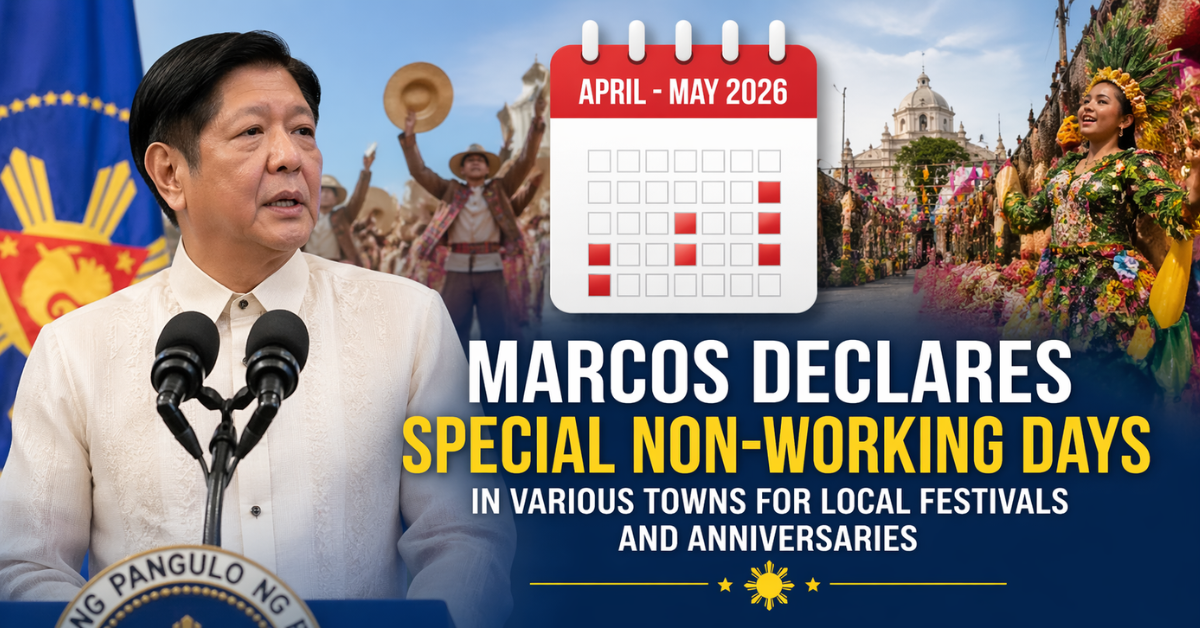
MANILA, Philippines — President Ferdinand R. Marcos Jr. has declared multiple special non-working days in various parts of the country, giving residents the opportunity to celebrate local festivals, cultural events, and town anniversaries.
The proclamations, signed by Executive Secretary Ralph Recto on behalf of the President, cover several dates in April and May 2026 and aim to promote cultural heritage while boosting local tourism and community participation.
Special Non-Working Days in April
Among the declared non-working days, April 30 has been designated as a special non-working day in:
- San Francisco, Quezon, for its founding anniversary
- Calatagan, Batangas, for its Cultural Day celebration
These non-working day declarations allow residents to fully participate in festivities that highlight local history and traditions.
May Non-Working Days for Festivals and Town Fiestas
Several towns across Luzon and Mindanao will also observe special non-working days in May:
- May 2 – Bauan, Batangas (Sublian Festival)
- May 4 – Taytay, Palawan (Pasinggatan Festival)
- May 8 – Camiling, Tarlac (Town Fiesta)
Additional non-working day celebrations include:
- May 15 – Calauan, Laguna (Pinya Festival)
- May 15 – Lucban, Quezon (Pahiyas Festival)
- May 22 – Gingoog City, Misamis Oriental (Lubi-Lubi Festival)
These festivals showcase Filipino culture through street dancing, agricultural displays, and religious traditions, making each non-working day a significant local event.
Purpose of the Non-Working Day Declarations
According to Malacañang, declaring a special non-working day ensures that residents can “fully participate in the occasion and enjoy the celebration.”
The government emphasized that these holidays:
- Strengthen cultural identity
- Encourage tourism in local communities
- Support economic activity during festivals
Eight Local Holidays Approved
In total, at least eight local holidays were approved across different provinces, reflecting the administration’s continued support for grassroots cultural events.
These non-working days are localized, meaning they apply only to specific cities or municipalities rather than nationwide.
What “Special Non-Working Day” Means
A special non-working day in the Philippines typically means:
- Government offices and some businesses may close
- Private companies may follow a “no work, no pay” policy unless otherwise stated
- Workers who report for duty may receive additional compensation depending on labor rules
Boost to Tourism and Local Economy
Experts say these non-working day announcements can significantly boost domestic tourism, as visitors travel to provinces to experience unique festivals like the Pahiyas Festival in Lucban or the Sublian Festival in Batangas.
By aligning local celebrations with official non-working days, the government ensures higher participation and increased economic activity for small businesses, artisans, and tourism operators.